


You may be eligible, even if you think you aren't!
Learn more about funded places for early years childcare



Making Communication Accessible: How We Use Makaton at Indigo
Nicola Borland
4 min read
Aug 4 2026
Making Communication Accessible: How We Use Makaton at Indigo
Communication is an important part of everyday life. It allows us to express our wants, needs, thoughts and feelings, build relationships with others, and feel included in the world around us.
At Indigo, we recognise that everyone communicates differently. One of the ways we support inclusive communication across our services is through Makaton.
What is Makaton?
Makaton was developed in 1972 by speech and language therapist Margaret Walker, alongside colleagues Kathy Johnston and Tony Cornforth. The name Makaton was created using parts of their first names: MArgaret, KAthy and TONy.
Makaton is a communication programme that uses speech, signs and symbols together to support communication. It can be used by people of different ages and abilities and provides additional ways to understand language and express thoughts, feelings, wants and needs.
How Does Makaton Work?
Makaton brings three important elements of communication together:
Speech: You continue to speak normally while communicating.
Signs: Key words are supported with signs. The signs used in Makaton in the UK are largely based on British Sign Language (BSL).
Symbols: Simple pictures and symbols can provide additional visual support to help with understanding and expression.
For example, when asking, “Do you want a drink?”, you would say the full sentence aloud while signing the key words “want” and “drink.”
This combination provides additional visual clues while continuing to encourage listening and spoken language.
What Are the Benefits of Makaton?
Makaton can have many benefits for communication, learning and inclusion.
It can support understanding by providing visual clues alongside spoken words. It also gives people an additional way to express their needs, wants, thoughts and feelings.
Using signs alongside speech can support the development of communication and spoken language. Being better able to communicate can also reduce frustration and anxiety, particularly when someone finds it difficult to make themselves understood.
Successful communication can help build confidence and independence, enabling people to participate more fully in everyday activities.
Makaton can also promote social inclusion, helping people communicate and interact with family members, friends, teachers, carers and the wider community.
The combination of speech, signs and symbols can support learning, memory, attention and understanding of new concepts. Makaton can be incorporated into many different environments, including homes, education settings, healthcare and community services.
How We Promote Makaton at Indigo
At Indigo, we are committed to making communication accessible and inclusive across our organisation.
One of the ways we do this is through our Makaton Change Makers Group. The group brings together team members from different settings across Indigo and is supported by Kirsty Dawson, our Speech and Language Therapist and Loving Language Coordinator.
During Change Makers sessions, our team has opportunities to share and learn Makaton signs, as well as learning how to sign stories and songs.
Sometimes, the group focuses on a particular theme that is relevant and interesting to people of different ages across the organisation, such as celebrations or Scotland. Team members can then take what they have learned back to their settings and share it with colleagues and the children, young people and families we support.
This helps us work collaboratively and encourages Makaton to become part of everyday communication throughout Indigo.
Children Becoming Makaton Champions
The enthusiasm for Makaton isn’t limited to our team!
In one of our school-age service bases, a group of children enjoy learning and sharing Makaton signs alongside Rose, who is a member of our Change Makers Group.
Giving children opportunities to learn and share signs helps make communication inclusive and enjoyable. It also allows children to develop new skills together and encourages them to recognise and value different ways of communicating.
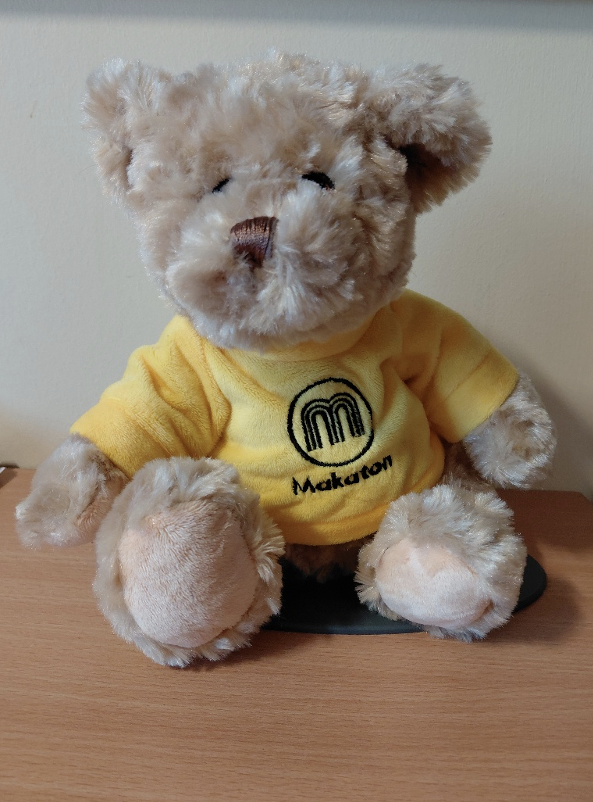
Meet Mak the Makaton Bear!
Within our Early Years bases, children under three have the opportunity to take Mak the Makaton Bear home with them.
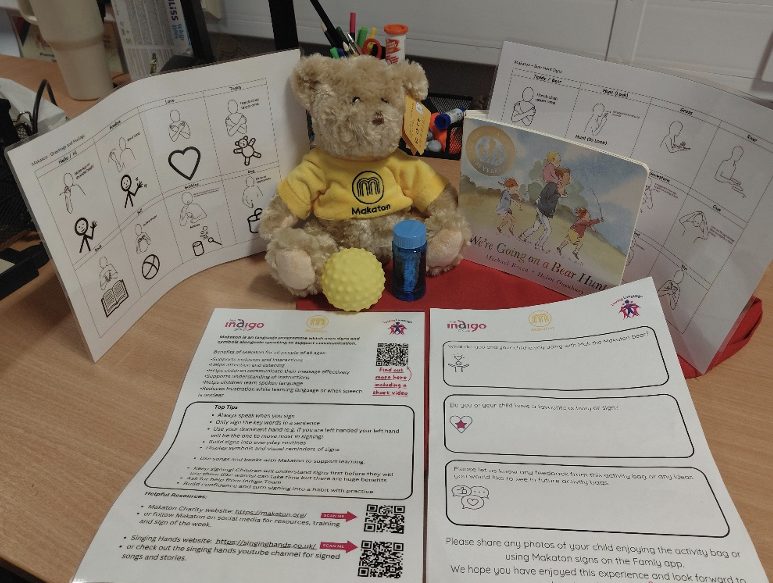
Mak is part of our Makaton home-learning bag, designed to encourage children and their families to explore communication and learn together at home.
Each bag contains:
- An information sheet
- A storybook
- Bubbles
- A sensory ball
- A printed sheet of core Makaton signs
- A feedback form
Families are encouraged to explore the activities in the bag, practise signs and enjoy spending time learning and communicating together.
By taking Makaton beyond our services and into the home, we can help families build signs naturally into their everyday routines.
The Impact of Makaton at Indigo
Introducing and promoting Makaton across Indigo has had a positive impact in many different ways.
It supports the development of communication and language skills, giving children and young people additional ways to express their feelings, wants and needs.
Having another way to communicate can help reduce frustration, particularly when spoken communication is difficult.
Makaton also supports inclusion and belonging. When children, young people, our team and families understand and use signs together, everyone has more opportunities to participate and communicate.
It helps us create an environment where all children are encouraged to communicate together, supporting equality, participation and a sense of belonging.
Our Change Makers Group has also encouraged collaborative working across Indigo’s services, helping our team share their knowledge and promote Makaton consistently throughout the organisation.
At home, our Makaton learning bags give families an opportunity to spend time learning together, while sharing new communication skills that can become part of everyday family life.
Most importantly, we are learning from one another. Children, young people, our team and families can all share their knowledge, practise new signs and celebrate their communication achievements together.
Our Top Tips for Using Makaton
If you’re beginning to use Makaton, remember:
- Always speak when you sign. Makaton signs support speech rather than replace it.
- Sign the key words rather than every word in a sentence.
- Use your dominant hand. For example, if you are left-handed, your left hand will usually be the hand doing most of the movement.
- Build signs into everyday routines. Regular opportunities to see and use signs can support learning.
- Display symbols and visual reminders to reinforce familiar signs.
- Use songs and books. They can make learning Makaton engaging, memorable and fun.
- Keep signing! Children may understand signs before they begin using them themselves, just as children often understand spoken words before saying them. Learning takes time, so consistency is important.
Communication Is for Everyone
Makaton is about more than learning individual signs. It is about giving people additional opportunities to understand, express themselves, connect with others and participate.
By learning and sharing Makaton across Indigo, we can continue creating environments where different ways of communicating are recognised, supported and celebrated.
Whether it is a child learning a new sign with their friends, a team member sharing what they have learned at a Change Makers session, or a family exploring Mak the Makaton Bear’s home-learning bag together, every sign can help make communication more accessible.
Helpful Resources
The Makaton Charity
The official Makaton website provides further information about Makaton, training, resources and ways to get involved.
Singing Hands
Singing Hands provides songs, videos and resources that use Makaton signing, offering a fun and engaging way to practise and learn signs.